Scientific Illustration by Subject: Birds
Audubon, John James (1785 -1851)
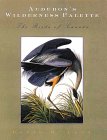
Audubon's Wilderness Palette : The Birds of Canada
by David M. Lank
"In the summer of 1833, John James Audubon, his son and several friends embarked on the schooner 'Ripley' and sailed from Eastport, Maine to Nova Scotia to the St. Lawrence. Audubon kept a detailed diary describing the land, the sea, the vegetation, the people and, above all, the birds that he encountered. Many of the paintings he created along the way are considered his most beautiful and are reproduced here in 'Audubon's Wilderness Palette.' Many of the birds represented here have become extinct or are threatened. With the strokes of his brush, Audubon has in many ways preserved a natural legacy, permitting those who view his paintings and engravings the opportunity to visit a world that has vanished."
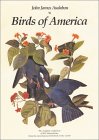
Birds of America
by John James Audubon
"Unlike the drawings and paintings of his contemporaries, which were produced from prepared skins and zoo specimens, Audubon’s paintings are taken directly from his observations in the wild, and the richness and directness come straight from the real world. No wonder that Audubon became known in his lifetime as 'The American Woodsman.' These paintings were produced between 1828 and 1837; between 175 and 200 sets of these paintings were produced, and the last complete set to come to auction fetched nearly $3 million. The prints of this edition are almost exactly one-half size of the original life-size paintings.
"Originally published at a 30 x 27” trim so that Audubon could paint life-size renditions of the birds, this edition contains 435 full-color reproductions of hand-colored aquatinted plates taken from a rare subscription copy at the Cambridge University Library. The descriptive matter is written by Dr. Colin Harrison, who is the author of the standard reference A Field Guide to Nests, Eggs and Nestlings of North American Birds and was for 26 years a scientific officer of the British Museum of Natural History, and Cyril Walker, a senior scientific officer of the British Museum of Natural History."
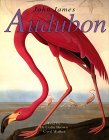
Audubon: American Birds
by John James Audubon, Colin Brown, Cyril Walker
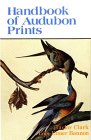
Handbook of Audubon Prints
by Lois Elmer Bannon, Taylor Clark
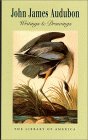
Writings and Drawings (Library of America, 113)
by John James Audubon, Christoph Irmscher
"John James Audubon's indelible portraits of American birds have long since cemented his reputation as one of our truly magical realists. Yet the artist, who was born in Haiti in 1785 and died 66 years later on his 30-acre estate in upper Manhattan, was not only a sublime featherhead but a trailblazing nature writer and diarist. Doubters should take a gander at the Library of America's splendid Writings and Drawings. This new compendium features 64 full-color plates, most of them from the Ornithological Biography, which demonstrate the compositional and dramatic brilliance that Audubon brought to his work: seldom has the black vulture, or Coragyps atratus, looked so elegant or sleekly satisfied, and his colloquium of ruby-throated hummingbirds (a.k.a. Archilochus colubris) is an almost comical study in group dynamics. Yet it's the texts--journals, letters, diaries, a brief memoir, and a pair of essays on artistic technique--that are the true revelation here.
"Audubon was not, for the record, a kind of starry-eyed precursor to the Sierra Club, leaving nature untouched by human hands. It's telling that in his self-portrait, the artist is gripping neither palette nor paintbrush but a flintlock rifle. Gunning down his ornithological subjects was a necessary prelude to portraying them. Still, Audubon had quite a few of what we moderns would call conflicted moments, during which his admiration for, say, the Mississippi kite would temporarily halt the killing spree. Here the sight of a mother attempting to rescue its chick manages to stay his itchy trigger finger--for a millisecond, anyway:
My feelings at that moment I cannot express. I wished I had not discovered the poor bird; for who could have witnessed, without emotion, so striking an example of that affection which none but a mother can feel; so daring an act, performed in the midst of smoke, in the presence of a dreaded and dangerous enemy. I followed, however, and brought both to the ground at one shot, so keen is the desire of possession!
"The aesthetic and taxidermal impulses have torn apart many a naturalist since then (although, to be sure, the stricken diarist was later annoyed to discover that another animal had cut in on his action: "What was my mortification, when I found that some quadruped had devoured both!") Elsewhere, Audubon records the topography of the Mississippi Valley in vivid detail, or grumbles about the tight job market: 'Visited several Public Institutions where I cannot say that I Was very politely received; in one or Two Notable ones (Not Willing to Mention Names) I was invitd to Walk in and then out in very quick order.' Audubon's early-19-century orthography, which the editors have meticulously retained, may take some Getting Used To. And the sheer piling up of avian corpses can seem almost comical to a modern reader. Still, Audubon worshipped pretty thoroughly, and very productively, at the shrine of the natural world. And let's recall his verdict on Liverpool's industrial landscape, which he observed during a 1826 visit: 'Naked streets look dull.' If only there'd been a long-billed curlew on hand! --James Marcus
Birds: The Art of Ornithology by Jonathan Elphick and Robert Prys-Jones.
Also See:
John James Audubon: Bird Illustration
John James Audubon: Wildlife Illustration
Index to Scientific Illustrators: Bird Illustration