Microscopic Illustrations
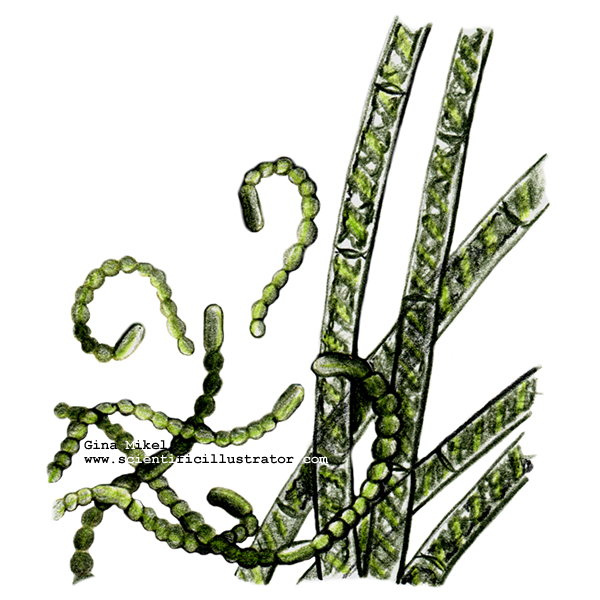
Algae, colored pencil and watercolor
Commissioned by: Minnesota Department of Natural Resources
About cyanobacteria:
The bracelet-shaped algae depicted in this illustration is cyanobacteria, also referred to as blue-green algae. This image, specifically, is a genus of filamentous cyanobacteria referred to as anabaena. It is found as plankton. Anabaena produce neurotoxins, which are harmful to animals. Anabaena form heterocysts, the larger circular cells depicted in the illustration above. Heterocysts provide the cells with nitrogen for biosynthesis. Cyanobacteria are actually prokaryotes (bacteria). Most are found in freshwater.
Kingdom: Bacteria (unicellular microorganisms, prokaryotes)
Division: Cyanobacteria (obtain energy through photosynthesis, blue-green algae)
Class: Cyanophyceae
Order: Nostocales
Family: Nostocaceae
Genus: Anabaena
About spirogyra:
The ribbon-shaped algae in the illustration above is spirogyra. It is a filamentous green algae found in freshwater. Spirogyra is photosynthetic and eukaryotic.
Kingdom: Protista (unicellular or multicellular without highly specialized tissues)
Division: Charophyta
Phylum: Chlorophyta (green algae, mostly aquatic photosynthetic eukaryotic organisms)
Order: Zygnematales (members of this group develop into unbranched filaments one cell thick)
Family: Zygnemataceae
Genus: Spirogyra
More about the algae in this illustration:
Wikipedia: Anabaena
Wikipedia: Heterocyst
Wikipedia: Spirogyra
Wikipedia: Bacteria
Wikipedia: Cyanobacteria
Also see:

anabaena
| Keywords related to art on this page: algae illustrator, aquatic, art, artwork, image, picture, illustrations, images, pictures, macroscopic, microscopic, water, alga, bacterium, spirogyra, blue-green, cyanobacteria, microbiology, bacteriology |